

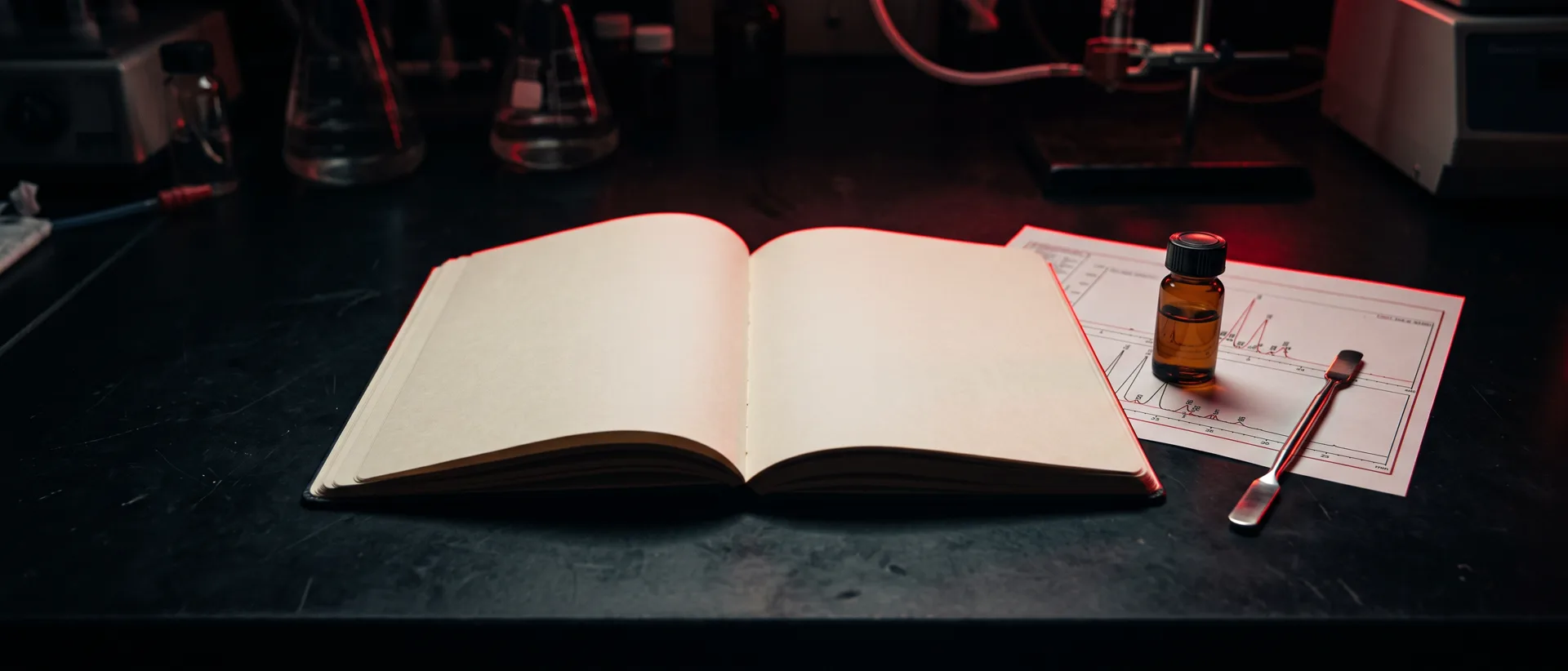
“Are peptides safe?” is a question about biology, and nothing on this site answers it. What can be answered, and what actually decides whether a research material is fit to work with, is quality: is it the molecule the label says, how pure is it, how much of the powder is peptide, was it handled properly, and can any of that be checked against a document. This page covers only that.
Key facts
- No safety, health or efficacy guidance is offered here. These materials are for in-vitro laboratory research and are not for human or veterinary use.
- Identity is established by mass spectrometry: the observed mass must match the theoretical mass for the sequence.
- Purity is measured by reverse-phase HPLC and reported as area percent at a stated wavelength, ideally with the chromatogram attached.
- Peptide content, not label mass, is what tells you how much peptide is in the vial — typically 75 to 90 percent of the powder.
- A certificate is only meaningful when its lot number matches the vial in your hand. Request the certificate of analysis for the lot before ordering.
What a quality question can actually establish
Four things, and only four: what the material is, how much of it is the thing named, what else is in the vial, and whether it has been kept in conditions that preserve it. Each of those has a measurement behind it, and each appears on a properly written certificate.
Identity
A mass-spectrometry trace with an observed molecular weight next to the theoretical one. A match confirms the molecule is the sequence on the label. It says nothing about how much of it is present, which is a separate measurement entirely.
Purity
Reverse-phase HPLC, reported as area percent. A purity figure with no chromatogram behind it is an assertion rather than a measurement, and two lots that both say 98 percent can be describing quite different materials depending on whether the remaining two percent is one related impurity or a dozen small ones. The comparison method is set out in 98% versus 99% purity.
Peptide content
A lyophilised vial holds peptide plus residual water plus counter-ions from purification. A vial labelled 10 mg at 82 percent peptide content holds roughly 8.2 mg of peptide. Where your work depends on the mass of peptide rather than the mass of powder, this figure is not optional.
Endotoxin and what a certificate omits
A standard certificate does not establish sterility, and it does not establish that a material is endotoxin-free unless a specific endotoxin assay is listed on it. For cell-based work that distinction matters and should be asked about directly rather than inferred — what a certificate does and does not cover goes through the gaps in detail.
Storage and handling
Dry material is far more robust than solution. Lyophilised peptide stored sealed at −20 °C, protected from light and moisture, is stable for a long time; the same material in solution is not, which is why storage guidance changes the moment a vial is reconstituted. Bring a cold vial to room temperature sealed before opening, so warm air does not condense water onto cold powder. The full handling reference is in storing lyophilised research peptides.
Counterfeits and how to check a vendor
The failure mode that matters in this market is not a dramatic one. It is an underfilled vial, a lot certificate that belongs to a different lot, a purity figure with no trace behind it, or a generic specification sheet supplied in place of a real document. All four are caught by the same request: ask for the batch-specific certificate for the lot that would ship, and check the lot number on it against the vial when it arrives.
- Batch-specific certificate naming the lot, not a sample document
- Chromatogram present, not just a headline number
- Peptide content stated
- Lyophilised powder with an intact seal and an undisturbed cake
- Lot number on the vial matching the lot number on the paperwork
Aegis Bio supplies a certificate by request for the batch shipped, covering HPLC purity and mass-spectrometry identity. How each section of one is read is covered in how to read a certificate of analysis.
What this page does not cover
Anything about effects, suitability for a living system, or use in humans or animals. Those questions are outside what a research-material supplier can answer, and answering them would change what the material is being offered as. The policy is on the compliance page; ordering and shipping detail is on the FAQ; current offers are listed on the sale page; what is collected at checkout is in the privacy policy.
All materials are supplied for in-vitro laboratory research use only and are not for human or veterinary use. Nothing here is a therapeutic claim and no dosing guidance is provided.