

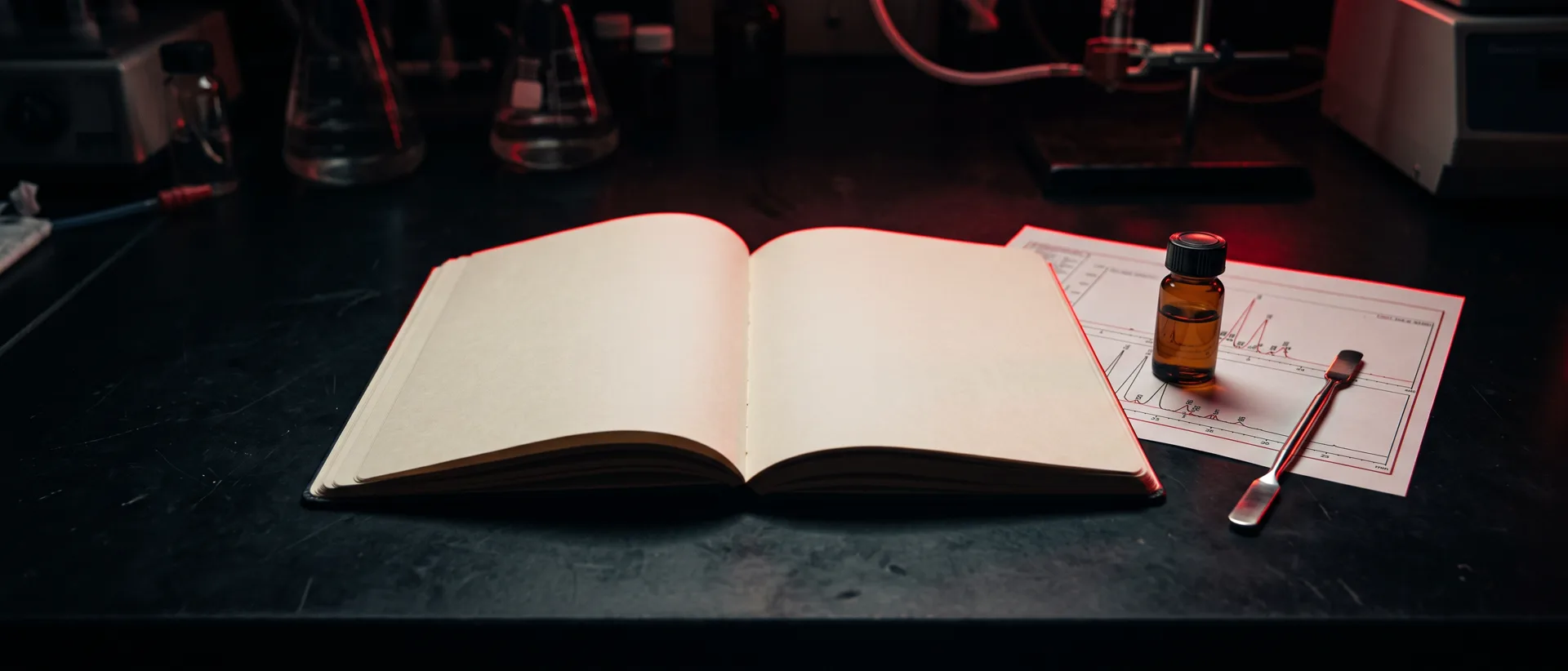
A certificate of analysis is the only document that connects the label on a vial to measured data. It is worth knowing how to read one properly, because two lots that both say “98% purity” can be describing meaningfully different things.
The four sections that matter
1. Identity
Usually a mass-spectrometry trace with an observed molecular weight next to a theoretical one. What you are checking is simple: does the observed mass match the expected mass for that sequence, within the instrument's tolerance? A match confirms you have the molecule named on the label. It says nothing about how much of it is in the vial.
If the observed and theoretical masses differ by 18 Da, that is a water molecule — often a sign of a cyclisation or hydrolysis difference. A difference of 22 Da is commonly a sodium adduct. Neither is automatically a problem, but both are worth asking about.
2. Purity
Almost always reverse-phase HPLC, reported as area percent at a stated wavelength (usually 214 nm or 220 nm, where the peptide bond absorbs). The number is the area of the main peak divided by the total area of all peaks.
Two things to look at beyond the headline figure:
- Is the chromatogram included? A purity figure with no trace behind it is an assertion, not a measurement. A real COA shows the chromatogram.
- What is the largest impurity peak? 98% purity with a single 1.5% related peak is a different material from 98% purity spread across a dozen small peaks.
3. Peptide content vs net peptide weight
This is the section most often skipped, and it is the one that changes what you actually receive. A lyophilised peptide vial contains the peptide plus water plus counter-ions — typically trifluoroacetate (TFA) or acetate from the purification step.
A vial labelled 10 mg with 80% peptide content contains roughly 8 mg of actual peptide. A vial labelled 10 mg with no peptide content stated could be anywhere in that range. If your work depends on knowing the mass of peptide rather than the mass of powder, this figure is not optional.
4. Appearance, solubility and storage
Usually brief: white to off-white lyophilised powder, soluble in water or a stated solvent. Deviations here are worth a question — a peptide described as white that arrives visibly yellow is not necessarily degraded, but it is a reason to ask for the lot's retained sample data.
What a COA does not tell you
It does not tell you the material is sterile. It does not tell you it is endotoxin-free unless a specific endotoxin assay is listed. And it describes the lot that was tested — which is why a COA is only meaningful if the lot number on it matches the lot number on your vial.
Practical checklist
- Lot number on the COA matches the vial in your hand
- Chromatogram is present, not just a purity number
- Observed mass matches theoretical mass
- Peptide content is stated, or you have asked for it
- Test date is recent relative to your delivery
Aegis Bio supplies a certificate of analysis by request for the batch shipped, covering HPLC purity and mass-spectrometry identity confirmation. Request the COA for a specific lot before ordering if your protocol requires documentation on file.